


Project Overview
A.I.L.A. is a first-person psychological horror game developed by Pulsatrix Studios and published by Fireshine Games. The player takes the role of a grieving father being psychologically manipulated by a malevolent AI entity known as A.I.L.A, which constructs virtual environments to explore and exploit his deepest fears, traumas, and memories.
Impossible House is the first level in the game where environments are explicitly authored by A.I.L.A within the narrative. This case covers Part 1, the player's first encounter with A.I.L.A's constructed spaces and the layered environment system that defines them.
What I did:
-
Initial level concept development
-
Creation of the blockout
-
Definition of the layered structural system
-
Environmental puzzle design
-
Iteration of puzzles and item placement based on internal playtests
Tech Details:
-
Unreal Engine 5

My role
I worked as Level Designer on this project, with full responsibility for the initial concept, structural layout, and blockout of Impossible House. The design phase was developed in close collaboration with one programmer. The original structural layout was preserved without modification through to the final release — all subsequent iterations focused on puzzle clarity and interaction readability, not the spatial architecture itself.
-
Introduce the concept of environments created by A.I.L.A. within the narrative
Demonstrate how spaces constructed by the in-game AI operate structurally and systemically.
-
Teach the layered environment system
Ensure players understand how to switch between different states of the same space.
-
Familiarize players with interaction mechanics
-
Item collection
-
Equipping items
-
Combining items with environmental elements
-
Solving environmental puzzles
-
-
Introduce backtracking as part of the core gameplay loop
The original vision
The design brief established that Impossible House would be the first level constructed by A.I.L.A within the game's narrative. My starting point was a question: what would an AI design to psychologically analyze a person?
I thought of tests like the Rorschach inkblot, free word association, or dream description, tools designed not to find answers, but to reveal what someone projects onto ambiguous stimuli. I wanted the level to function the same way: a space designed by A.I.L.A. to learn about the protagonist's moral conflicts, buried traumas, and fears.
The core mechanic I designed around this concept was a layered environment system: a single physical space that exists in four distinct states. The player begins confined in a neutral default state (Layer 0) with a single locked door and no way forward except to find the remote control and interact with a television. Each subsequent channel change transitions the space to the next layer in a fixed sequence, each themed around a different psychological dimension of the protagonist:
-
Layer 0: Default contained starting room.
-
Layer 1: the corridor door requires a biometric scanner, keeping the player contained while introducing the lock mechanic.
-
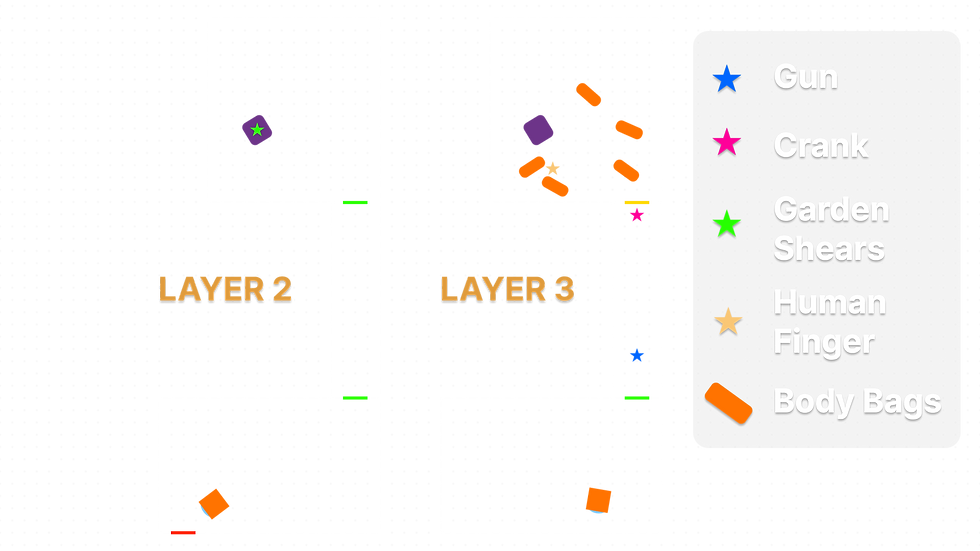
Layer 2: the door is unlocked, granting access to the large room and the first key item.
-
Layer 3: the level is flooded, the large room sealed, and the space feels its most threatening.
In the original concept, each layer's TV image acted as a Rorschach-style prompt tied to the protagonist's psychology: a sunlit farm for nostalgia, a night highway for trauma, empty bottles for guilt. The puzzles and objects in each layer were conceived to quietly reinforce these themes through environmental implication rather than explicit narrative text.

Structural design
The level is deliberately contained and linear. There are no branching routes, progression depends entirely on understanding and using the layered system, not on spatial navigation. The environment is claustrophobic by design: Tight rooms, narrow corridors and the bsence of traditional wayfinding landmarks.
Disorientation was intentional, but systemic rather than spatial.
One subtle but deliberate structural decision was the positioning of the television in each layer. Rather than fixing the TV in a single location, I placed it facing a different wall in every state: left wall in L0, right wall in L1, facing the far wall at a diagonal in L2, and aligned with the corridor in L3. This meant that every time the player transitioned between layers, the TV's orientation quietly directed their attention toward a different part of the room, functioning as indirect wayfinding without any explicit marker or UI.
Players were unlikely to consciously notice it, but it shaped where they looked first upon arrival in each state.
The initial item placement in Layer 0 followed the same logic at a smaller scale: the TV sits on the left wall and the drawer containing the remote control sits on the right. Placing them at opposite ends of the room was a deliberate choice to force the player to read the entire space before they could interact with the only element that unlocks progress.
The layered system itself was my original concept, built on top of a scene-switching framework inherited from Fobia, the studio's previous title, and adapted for the new psychological framing of A.I.L.A.


Where the vision shifted
Internal playtests revealed two problems — one I had anticipated, and one I had not. The expected problem materialized as predicted: players struggled with backtracking logic and cross-layer dependencies, cycling through layers without knowing what they were looking for. That was acceptable friction by design.
The unexpected problem was that the narrative-puzzle connections were not reading clearly enough. Players were not understanding what they needed to do next, independent of the atmospheric confusion I intended. The thematic imagery (calm farm, highway at night, empty bottles) was too abstract to guide action.
In response, the team made the decision to shift the thematic emphasis of the puzzles. Rather than centering the layer themes on the protagonist's personal psychology, the level leaned into A.I.L.A's interpretation of information available to her. Early in the game, the protagonist watches a news broadcast about a serial killer, known as the Eye Killer, who murders victims by removing their eyes and amputating their fingers or hands. A.I.L.A, having registered this as significant input, incorporates these elements directly into the constructed environment:
-
A victim found inside a refrigerator in Layer 1 offers the player her extracted eye, which is used in a retinal scanner puzzle in the corridor.
-
In Layer 3's large room, body bags are tagged with names, the player must identify the correct one and use the garden shears to collect a finger, which unlocks the biometric scanner in Layer 1.
-
The televisions across the level gain a new layer of meaning, now connected to the act of watching the news at home — the origin of A.I.L.A's information about the Eye Killer.
The original psychological themes (nostalgia, trauma, guilt) were not abandoned. They became subtext. The shift made the level more playable without erasing the conceptual layer underneath. For most players, the Eye Killer framework provides the puzzle logic. For attentive players, the original symbolic reading is still there.
What worked
The claustrophobic atmosphere consistently achieved the intended effect (playtesters and players responded to the sense of strangeness and unease as designed). The layered system successfully introduced the core structural logic of A.I.L.A's environments, preparing players for the expanded version of this mechanic in Part 2. The structural layout required no changes from blockout to release, which validated the foundational spatial design. Watching organic gameplay footage of players reacting to the level, noticing what they noticed, hesitating where I expected them to hesitate, was one of the most instructive experiences of my early development as a designer.
What I would do differently
The original conceptual framework: A.I.L.A as a psychological analyst constructing a Rorschach-style space, was the most creatively ambitious idea I brought to this project. In retrospect, I would invest more time earlier in the process designing the affordances that would make those thematic connections legible to players without explaining them. The iteration pressure that pushed the design toward the Eye Killer framework was valid, but I believe a stronger initial pass at indirect narrative cues could have preserved more of the original vision in the final build.
I would also develop the TV positioning system more explicitly from the start, documenting it as a formal wayfinding mechanic rather than an intuitive placement choice, so it could be playtested and iterated on with the same rigor as the puzzles.
Key learnings
-
Atmospheric intent and gameplay clarity are not always in conflict, but resolving their tension requires deliberate design from the start, not iteration alone.
-
Environmental storytelling depends on affordance as much as symbolism. A meaningful object that players don't notice or understand fails on both levels.
-
Subtle systems (like the TV's changing orientation) can carry real design weight even when players don't consciously register them. The effect is felt, not analyzed.
-
Structural integrity and thematic integrity are separate things. The spatial layout of this level held from blockout to release. The thematic layer required compromise. Understanding that distinction was a formative lesson.
-
Watching real players engage with your level is irreplaceable. No internal playtest fully replicates the organic experience of someone encountering your design without context for the first time.